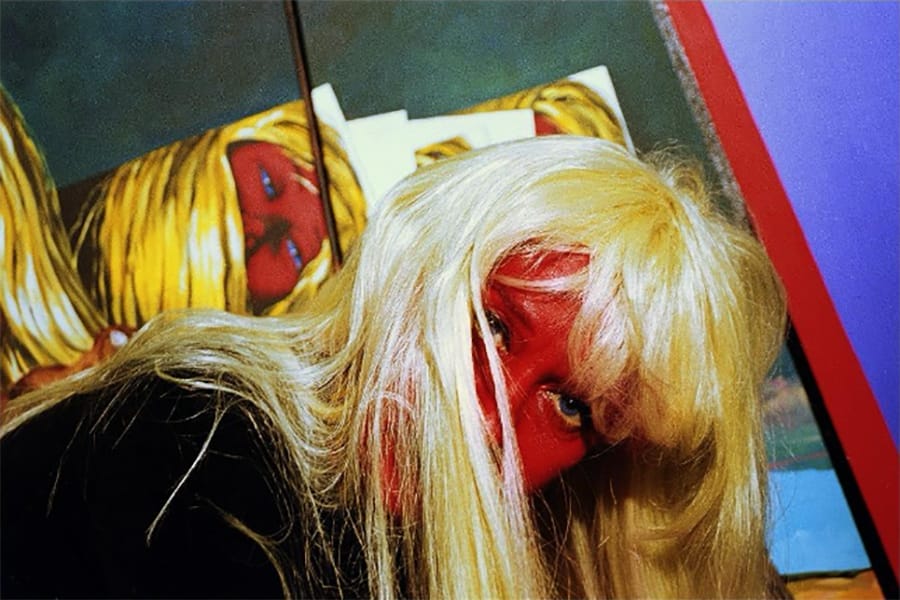
Once Upon a Time is a self portrait, a persistent presence throughout the artist’s life. One of the first examples is dated 1967 when she painted herself as a five-year old. In the 1997 version we can see an excercise of imagination, a performative aspect and a scenic preparation before the work is undertaken. The artist appears transformed in a blond wig, blue contact lenses, red gloves, red-painted face and black lipstick. Varela is clutching a child’s teddy bear and other reminders of her childhood float over the surface of the canvas. Other references to this specific period in her life are recurrent in her work. A 3×4 cut out of this portrait remind us of the snaps taken in a photo booth. The same figure appears again in the lower part of the canvas, this time with gloves, a blue-painted face and wind-blown hair. The geometry, so characteristic in her earlier paintings, also catches the eye in the lineal structure of the artist’s easel which dominates across the canvas. And finally, the Brittany landscape forms the background, specifically the Standing Stones of Carnac, a dense collection of 3,000 dolmens and menhirs erected more than 5,000 years ago by hunter-gatherer communities.
This landscape substantiates another fundamental aspect of Valera’s work: the coexistence and superimposition of different historical references and periods. Her years of art history studies at the École du Louvre and social anthropology at the École Pratique des Hautes Études where she studied the body painting of various indigenous peoples, played an important part in this development. In Once Upon a Time the symbolic and spiritual weight of the pre-historic monuments, erected to pay tribute and perform pagan rituals to the dead, cross paths with the reference to the use of natural red pigments as a form of protection and defence associated with shamanism and the cultures of certain native peoples.
In the year following this painting Varela again interpreted the same role in a series of photographs. Photography figured early on in her creations, either as stand-alones or as support in her paintings. Photography has almost always maintained a dialogue with painting and in some cases Cybèle reviewed her canvases and created new compositions of performances, based on the relevant images. In photographs of the Why? and the Once Upon a Time series, using as a starting point and backcloth the 1997 painting of the same name, the artist has constructed a sort of housewife’s diary based on simple actions like cleaning one’s teeth or curling one’s hair. This repetitive routine is evocative of Jeanne Dielman portrayed by the Belgian film director Chantal Akerman. However, unlike the filmed personage, Cybèle allows herself the luxury of blowing soap bubbles and having fun with her own image. Even so, like Akerman, Varela’s photographs ridicule the suffocation of an isolated domestic life without perspectives and the difficulties in reconciling it with a profession.
The ballet shoes point us to part of the essence of the works: they are for flight and escape. At the same time they are a metaphorical hint at the ideal of beauty and lightness that carries a heavy burden of dedication and personal sacrifice beneath. More specifically, the ballet shoes also refer to some female garments and other painful daily habits adopted by women through the centuries that have conditioned their physical aspect, their movements and their freedom of expression.
Isabella Lenzi. June 2024

 Download room sheet in PDF


